
 Image caption
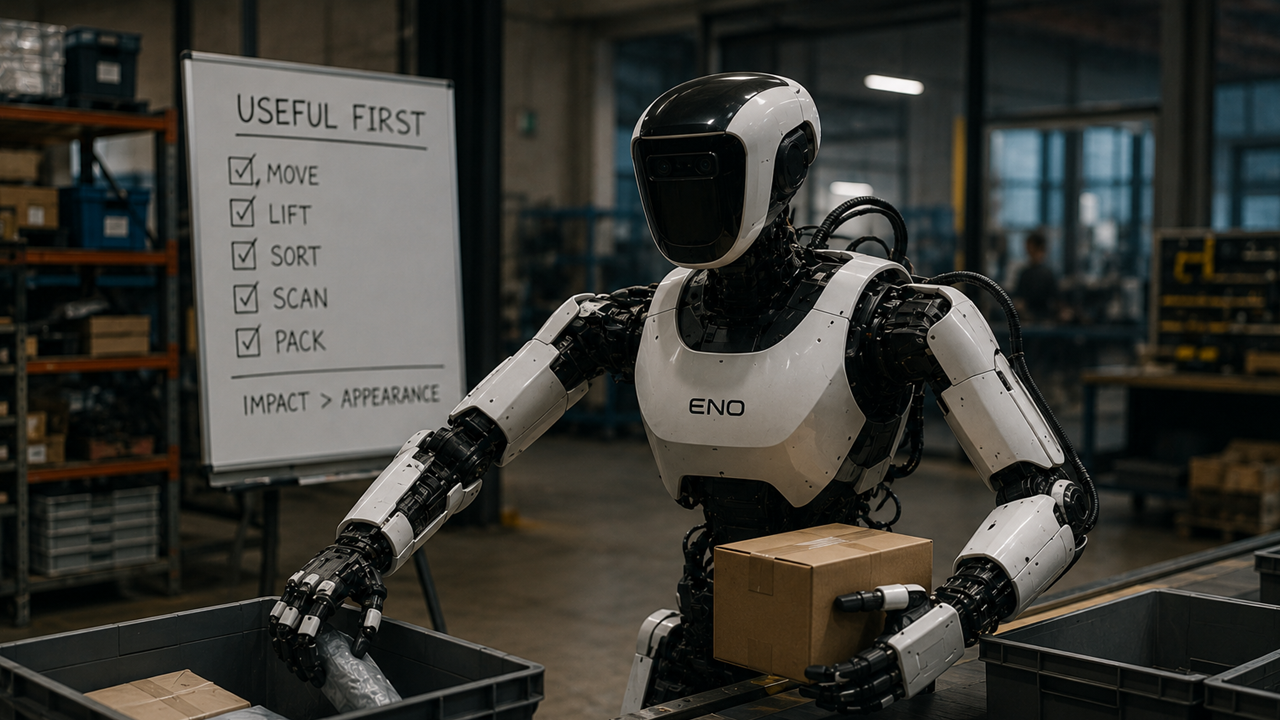
Practical warehouse robot Eno handling boxes beside a "Useful First" checklist, prioritizing real work over human-like appearance.
The signal
Genesis AI has shown Eno, a general-purpose robot that deliberately does not chase the full human silhouette. The Verge reports that Eno may use a wheeled base, may not need a head, and is built around "human capability" rather than human appearance.1 The broader robotics stack is moving the same way: NVIDIA's GR00T work frames generalist robots as a foundation-model and simulation problem, not only a costume problem.2
That is the interesting part. The public robot story keeps getting pulled toward faces, legs, viral walks and little moments that look like science fiction finally paying rent. Fine. Those clips matter because they make the category legible. But the appeal of robotics will not be decided by whether the machine looks like a person. It will be decided by whether it can safely move through human spaces, use human tools, recover from small failures and do useful work without turning every task into a demo.
Eno's hands are the tell. A robot can skip the human costume and still need human-compatible manipulation. Doors, handles, carts, tools, shelves, lab instruments and packaging lines were designed around human reach and grip. If the robot can use those interfaces, it does not need to win a beauty contest. It needs balance, dexterity, judgment, repairability, energy discipline and a body shape that makes sense for the job.
The risk
The weak version of the robotics hype says: humanoids are here, therefore labor changes next quarter. That is too clean. Real deployments are slower and less glamorous. Manufacturing floors, warehouses, hospitals and homes are full of edge cases. A robot that performs well in a video still has to survive bad lighting, odd objects, impatient humans, narrow spaces, low batteries, dirty sensors and all the boring mess of ordinary work.
NVIDIA's robotics work explains why the field is moving anyway. Its GR00T N1 paper frames humanoid robotics as a foundation-model problem: robots need perception, language, action and training data that generalize across tasks.2 A newer Isaac Sim survey makes the infrastructure point from another angle: simulation, synthetic data and GPU-accelerated training are becoming part of the robotics stack, not a side tool.3 So the race is not only hardware. It is bodies plus data plus models plus simulation plus customers patient enough to test the thing in public.
The Appeal
- Useful robots do not have to look human to serve human spaces.
- The strongest signal is practical deployment, not theatrical resemblance.
- The upside is real if the technology reduces dangerous, dull and fragile work.
The optimistic case is not that robots replace people in one clean wave. The better case is narrower and stronger: machines take on repetitive physical work, extend skilled teams, keep labs and factories moving, and eventually make home assistance less like a gadget fantasy. The appeal is not the robot pretending to be human. The appeal is a useful body for useful intelligence, with enough restraint to avoid selling a cartoon future before the machine can handle a normal Tuesday.